"Whoa, this is cool."
"Check it out, the tables are so open and scattered."
"I love the different types of tables, feels like a cafe."
Yes, these are the responses I was hoping for. Very rewarding when inspiration leads to a well executed plan. Today, our first day back was awesome. For many reasons: Furniture arrangement, classroom design, choice, mindfulness lesson and purposeful conversation are just a few of them. Coming back from a long break is hard. Our focus is lacking, its difficult to get wake up early after sleeping in late for awhile, our mindset is not aligned with learning new stuff. We often forget our mindfulness, because we have been out of our routine.
So today as much for me as for them, I had another mindfulness lesson. We generally talk kindness and mindfulness at the beginning of the class every day but today we spent fifteen minutes, just reconnecting and realigning as a classroom community. The warm up question: What two things upset you, or make you stressful through out most days and how do you cope or deal with them? This sparked a lot of discussion. Mostly, not about complaining or venting, but on their actions in dealing with the stressful situations.
"I yell at my younger brother."
"I throw something, or say something mean."
"I retreat and try not to deal with my frustration."
After about five minutes of reflection- I introduced a video clip by saying- "It is none of their business that we are mad at them. It is our business to deal with our emotions. It is alright and expected, that we will get mad and anxious- it is our awareness and strategies on how to overcome these, that makes us mindful."
This is the video clip I showed. https://www.youtube.com/watch?v=vzKryaN44ss
After they watched it, I can't believe how engaged they were, they had purposeful talk discussions at their tables. It was beautiful to watch their expressions and realizations. During a class discussion, we talked about anger and how it alright to be angry, we need to embrace it. But we need to remember to feed the positive, loving, compassionate wolf. Both wolves need to be expressed. We just have to make sure we let our anger and frustration go. Then they wrote in their mindfulness journals: "It is none of their business that we are angry. It's our business and we have to deal with our business. They have their own business to attend to."
After our mindfulness discussion students began their exploration of local Texas flora and fauna. They were asked how turtles, squirrels, and bugs alike and how and why are they different? We have not spoken about adaptations yet, this is the introduction to the unit and I had them use Texas Wildlife articles from Critter Connections Magazine, to really get them thinking about what they see around them. Local flora and fauna. Since the classroom was rearranged into smaller table settings, more meaningful, purpose conversations ensued.
At the end of class I asked them, table by table, what they noticed about the classroom culture.
"It seemed lighter, calmer."
"We don't feel like were having a classroom conversation, but more personal ones."
"I like the new design, you were able to move around more and sit down with us."
Mindfulness lesson, purposeful talk, science and investigation all in a new configuration and together, these set the tone and spirit, for a great first day back.
Tuesday, January 7, 2020

Monday, January 6, 2020
From a Dining Room Classroom Ambiance to a Coffee House Vibe (6)
My classroom has always been a place of conversation, interaction- a dining room style setting. Tables set up in long dining room table configurations. In the fall, it is a great way to spark discussions- a "pass the potato's" feel. But now after the holiday break I want students to come back to a different set up. A different atmosphere, mood, tactility. Today is a teacher work day. So I rearranged my room, took posters off the wall and added new focal points.
Now my classroom is more of a "stay awhile and have a cuppa joe" or "get comfortable my refill will be here soon" So now there are a few tables coming out from the wall, individual tables scattered about the room. It definitely feels more like a cafe now than a family dinner spot. It is a dramatic difference and I know when my students enter tomorrow, they are going to sense the alteration in spirit and aura. This should set the tone for the next semester.
Rather than having students pick up papers off the table, family style- I now have baskets on each table and the papers are in there. Almost like table tents, menus. This will get students to their seats much quicker and get them settled into learning.
I always have warm-ups but now, we will have a mindfulness prompt, a quick discussion and then our science probe will be displayed on the Smartboard- the menu board per se. This way they are reminded of the calm and focus that is appreciated before we begin our day. This should take no more than 5 minutes.
I have been doing this for awhile but I also had my science prompt displayed up at the beginning of class, for those who finish early. But they need to be brought in incrementally. Keeping them mindful with personal awareness and patience is so important and now I am going to focus just on mindfulness- no papers, no science for 5 minutes.
STOMP- stand, think, optimize, mindful, presence. It is my strategy (see earlier blog post) and it has worked great all year but it needs a little tweak. An update.
So every day will be a different letter focus, at the end of the prompt. A quick reminder. Then once a week we will do a ten minute step (one of the 5) more in-depth. This way when students are settling into the flow of daily classroom life and I am taking attendance they are focused on just one thing- mindfulness. Then once per week we can do a sum up and a bit more practice. I know I need a refresher and a reminder after the holidays, but not all at once. It is good to do brief, lessons, it gets overwhelming if it is all at once. So my plan, ease in to daily, classroom discussions.
I am hoping the new classroom design will help my students stay on track. Refocus their energy on a small group mentality, rather than a family dinner. Winter is the time we all get antsy and distracted because we have a long time until our Spring Break. The lull often causes boredom and misbehavior. Our next break is not until mid-March. So this is phase one of from dining room ambiance to a coffee house vibe. Phase one to stir things up and keep students and myself on collaboration, personal responsibility and purposeful, intentional conversation. More to come.
Before (Dining Room Ambiance) "Pass the potato's"


After (Coffee House Vibe) "Waiting for my cuppa joe"
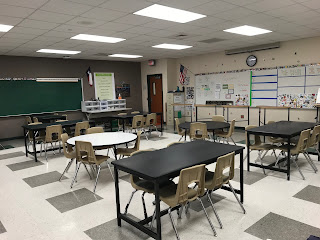

Now my classroom is more of a "stay awhile and have a cuppa joe" or "get comfortable my refill will be here soon" So now there are a few tables coming out from the wall, individual tables scattered about the room. It definitely feels more like a cafe now than a family dinner spot. It is a dramatic difference and I know when my students enter tomorrow, they are going to sense the alteration in spirit and aura. This should set the tone for the next semester.
Rather than having students pick up papers off the table, family style- I now have baskets on each table and the papers are in there. Almost like table tents, menus. This will get students to their seats much quicker and get them settled into learning.
I always have warm-ups but now, we will have a mindfulness prompt, a quick discussion and then our science probe will be displayed on the Smartboard- the menu board per se. This way they are reminded of the calm and focus that is appreciated before we begin our day. This should take no more than 5 minutes.
I have been doing this for awhile but I also had my science prompt displayed up at the beginning of class, for those who finish early. But they need to be brought in incrementally. Keeping them mindful with personal awareness and patience is so important and now I am going to focus just on mindfulness- no papers, no science for 5 minutes.
STOMP- stand, think, optimize, mindful, presence. It is my strategy (see earlier blog post) and it has worked great all year but it needs a little tweak. An update.
So every day will be a different letter focus, at the end of the prompt. A quick reminder. Then once a week we will do a ten minute step (one of the 5) more in-depth. This way when students are settling into the flow of daily classroom life and I am taking attendance they are focused on just one thing- mindfulness. Then once per week we can do a sum up and a bit more practice. I know I need a refresher and a reminder after the holidays, but not all at once. It is good to do brief, lessons, it gets overwhelming if it is all at once. So my plan, ease in to daily, classroom discussions.
I am hoping the new classroom design will help my students stay on track. Refocus their energy on a small group mentality, rather than a family dinner. Winter is the time we all get antsy and distracted because we have a long time until our Spring Break. The lull often causes boredom and misbehavior. Our next break is not until mid-March. So this is phase one of from dining room ambiance to a coffee house vibe. Phase one to stir things up and keep students and myself on collaboration, personal responsibility and purposeful, intentional conversation. More to come.
Before (Dining Room Ambiance) "Pass the potato's"


After (Coffee House Vibe) "Waiting for my cuppa joe"


Saturday, January 4, 2020
When You See a Good Move, Look for a Better One (4)
The Ascent
The
further they lure you away from your truth, the weaker your moves become. The
narrower your path. The more distracted you get. The more complacent you are.
You begin to react, its subtle at first, more like them.
You
see things, hear things, feel things that make you believe you want to go
further, wander off, because its easier to follow the pack than it is to travel
alone. You had a plan, you drew a map, made a list, packed a backpack. You took
out your compass and started your hike.
When
you saw them cliff side, looking out over their view, their landscape, you were
tempted to stop. Yet, you kept climbing. Brush became thick foliage, which
became tall, hearty trees, protecting you. You found your base camp.
The
silence was invaded by laughter, conversation, camaraderie. You smelled their
bonfire, saw the flames licking the sky, their sky, their campsite. Yet, you
pitched your tent in the solitude. It felt good to be separate.
So,
in the morning you ventured further on your hike, forgetting about the
travelers nearby. You drank clean, crisp water from the mountain stream. You
buried yourself in natures arms- watching, listening, feeling connected with
the equilibrium it offered.
When You See a Good Move, Look for a Better One
Stop trying so hard. I mean seriously. You know what happens when you do. You lose sight of your truth. You begin to kaleidoscope. All you need to do is breathe. In, out....in, out....in, out. Close the gap. Narrow the view. Hone in on the purpose.
Feel the pieces falling away from the board, one by one, until there is only one way to go. Look past the animation, the special effects and just immerse yourself in the why? Why do I find myself in this version, this side-quest, this campaign? Identify your move.
Not the right move, not the winning move, not even the most strategic- but your move. You'll know it when you see it. When you see a good move, look for a better one. When you know it, when it becomes part of you, do not hesitate. Make your move.
The Descent
The game is afoot- its always been in motion. We all have a role to play. We are all participating, we have no option.
But we have a choice on which role we are playing. We often play the fighter, the warrior- battling ourselves as much as others. We play the mage, the spell-caster, the cleric- magical yet lacking in the physical strength to take on the hoards of trolls alone. We must find a balance between these two archetypes because together- they are the wisdom, the fortitude to find the right solution.
To keep things interesting, we play the thief, the ranger to venture away from our true nature, to explore new possibilities. To go against the norm. Not to steal but to acquire, new moves, new strategies, new insights. To take one step further up the trail- alone.
Yet, once the precipice is sturdy below our feet, we have to pause. To see our view, our landscape. But also, to reach out and take a hand. So the descent is a safe one.
Thursday, January 2, 2020
Where is My Mind, My Name is Human (2)
Where is my mind?
Where it has always been. It gets clouded sometimes. Words get trapped in its
folds. It takes time for me to unravel the barrage of notes, melodies,
harmonies. The ultimate piece is just out of reach- I tend to get a chorus or
just a ditty. But my mind is my mind and for once it is just going to speak.
Okay so here is a bitter truth. Many days I am
happy, content. Seriously I am. I preach mindfulness and not to just seem
positive. It’s not a brand, I promise. I firmly live in the realm of mindfulness.
Plant my feet in its soil every day. I drink it in every day. Sometimes it
sprinkles, sometimes it pours. But it is always there. It’s not just a word or
behavior to me, it’s a spirit, the comfortable blanket I wrap myself in every
day. Honestly, I am a positive person, I see the good in people, yet, I also
internalize way more than I should. I am only human after all.
It seems unlikely right? Bitter truth, its
likely. Mindfulness is here in my mind.
Before I put my feet on the floor in the morning, I
hang them off the side of the mattress, let them dangle for a while and then I say
my intentions for the day. Usually three, I like a set of three, seems doable,
with a little push to stretch myself for the day. Its human nature to set
goals, make lists, organize our lives into something manageable- a guidebook,
it’s human nature. My intentions are always positive. Then my do-over is
something I need to work on like- forgive that comment you are dredging up
every five minutes, seriously let it go. Yes, my mindfulness sometimes has a
storm- its trying to keep it internal that keeps me mindful.
My morning intentions can be simple- smile,
breathe. They can be specific- connect with a certain student today, eye
contact and a positive affirmation. They can be lofty- be a moment of joy for
someone, be a good friend today. Lofty because, maybe friendship with me is never going to
happen. I am I have been told, a fast talker, kind of exhausting. This put me
in a tail- spin for days. Now when I am around this person, I am no longer
myself, I talk slower, more focused on my cadence than my words.
It’s something I have to work on- not them.
Impression is personal and no matter what we do, it’s not for us to change.
But, when we know about them, they shape us. They alter our perceptions of ourselves.
It’s human nature. My intentions have thus altered a bit, they are more focused
on what I can do, not on their impact on others.
Bringing joy to someone’s life can be lofty for many
reasons: people may not want joy, maybe their day requires they get up in the
morning and walk around in a cloud of Sulphur. Who am I to judge? Yet, it is my
nature, Melissa’s nature to spread mindfulness, often to the chagrin of those
around me. Maybe they are dealing with something they are not ready to share. Sometimes
leaving someone alone can bring joy. This I have to work on- finding the
balance between trying to help by a smile and conversation or just a smile.
Bitter truth, not everyone likes me.
Some days though, I am just not in a positive mood.
I hold a grudge, I am focused on something that went wrong, a negative comment.
I am restless, eager for change and I feel trapped in the mundane. Most days I
don’t mind the mundane- it’s the ritual, the routine that keeps my mind focused.
However, I tend to ‘burn the candle at both ends’ I
was reminded of this by a colleague just yesterday. I struggle with saying no.
To reign in my regiment of trying new things, taking risks, the need to
innovate. Here is the bitter truth, I need the approval of my work, the
recognition of a job well done, the acknowledgement of my time. When I don’t, I
feel bad about myself. I feel slighted somehow. Insane right? Actually, in the
scheme of things, its human nature.
The thing about me though, I bounce back really
fast. I feel frustrated for a bit but then I quickly see a new opportunity to
get creative. Another bitter truth, I venture so far outside my comfort zone, I
lose my way back. The thing is a comfort zone is there for a reason. Not to fence
in, but to provide the shape of the foundation, to wind with our whims and spontaneity.
It is not a box, but a wall we can leap over,
because without the barrier, we often feel we haven’t earned freedom. It
generally does not lead us to somewhere we don’t need to be. In fact, its
graffiti ravished interior of past failures, future possibilities are not
advertisements, not reminders, but predictions. All it takes is for us to jump
over. Its human nature to want to feel safe, yet long for something bigger.
With a name comes an ambiance and aura that creates
a self-image. I have a name it is nothing special. I mean I like my name, but
it’s not unique to me. I searched it on Google and records indicate that
745,408 girls in the United States have been named Melissa since 1880. Now in
the scheme of things, with over 7 billion people on the planet, it’s kind of
unique, but it is a name given, not chosen. I
have a species name. I have a title, a profession, a role. I even have a sense
of self, purpose. But ultimately, in the scheme of life, reality- my name is
human.
When we can peel back the layers, that is what we
are- human.
We need not feel guilty of feeling bad about
ourselves, comparing ourselves, hiding ourselves. We need not feel ashamed of
our need for connection, appreciation, acceptance. We need to share our
feelings because when we hold them in, the pressure starts to crumble that
wall. Then, we spend all of our time rebuilding rather than forming relationships.
The basic human need is companionship, camaraderie, community.
Yet, ultimately personal growth, personal compassion, personal whimsy and personal
joy is the glue. Sometimes, being human, we put all our energy in how they see
us, not how we see ourselves. We mold and conform to an image they stamped on
the outside of our wall and ignore the beautiful graffiti our lives have left
for us to admire.
It is not selfish to focus on you. Do what you need.
Feel what you need to feel. Awareness is the cement structuring mindfulness,
allowing it to grow higher, stronger. We need a view on which to gaze upon. We
need to know ourselves in the larger human nature, we find ourselves in. We
need the fortification, the draw bridge. The temple, the garden, the isolation.
But we also need the music of life, the laughter and
optimism that awaits us when we collide with the orbits of others. Just
remember an orbit is personal, a solar system has those who orbit beside you,
help hold you in place. Ultimately a galaxy, however endless it may seem, is the
main celestial home of humanity. Find those you collide with and keep your
orbit steady- that is true human nature. I don’t know about you- but my true name
is human.
Where is my mind? Right here, a cloudless day. Very
shiny indeed.
This post dedicated to you HJG. A cloudless day every day for me.
This post dedicated to you HJG. A cloudless day every day for me.
Sunday, December 1, 2019
You Have to Weave in the Metaphor, Most People want the Cold Water in the Face.
You have to weave in the metaphor,
most people want the cold water in the face.


Fancy candlesticks and centerpieces adorn the white tablecloth, every few feet. Although beautiful, shiny and decorative, they block many from having conversations, steering glances to those next to them, rather than across from them. The conversation switches from commonality, big ideas, to quiet differences.


The hazard of writing is
that for some it is a necessity, for me it a necessity. While reading is an
escape, I love to read because it gives me an escape from my necessity to write.
Not everyone wants to read personal blogs- not everyone gets
a book. The brutal reality of your life is just that, something for you to
figure out, some of us write to help with that. The hazard of writing is we
think someone else might want to read it. The mercy of it, we only need to
write for ourselves. Our truth is boring. Their truth is fascinating. There is
far more choice in writing for yourself, than in reading someone else’s
writing. You can write poetry, non-fiction and biographical essays. You can
write a journal or a story. You can scribble notes or take time to write for
days- free flowing or precise. Words only have meaning for you, unless you make
them relatable to someone else’s perspective. Sometimes when we read, we veraciously
read the entire book, eating up the words like morsels of personal inspiration.
Others we struggle to gain insight from and put on a shelf never to be
completed. Yet, from both experiences we gain knowledge. They shape our
writing.
So read, a lot and write a lot- it is those stories that shape
us.

Words are like the thin white paper they put between layers
of deli meat- when you aren’t looking, you try to separate a piece of
sustenance, but all you get is the paper. Then you turn to look, and you notice
you didn’t pull the paper apart. The whole process makes you hungrier and more
frustrated. Sometimes, I feel like the paper, others the meat. Now I know, big
metaphor, woven in just now, I can’t help myself. I am a water in the face gal,
when it comes to reading someone else’s truth, their personal story. But
writing truth, involves not only words for me, but images and thus imagery. I
think more in color and nuance than words. My mind forms sentences from both
exterior and interior visual input. Thus, my story often becomes metaphor on
its own. As much as I try to ‘stick to the fact’s mam’, - I tend to ‘hey, did
you see that?’ It’s just the way I think and express myself.
Just write, not for them, whoever they are, but for you.
That is the only way the words will actually form logical sentences. When you
try to make it funny or poignant- they fall short. Because to you, you are
always funny and poignant. My favorite person to talk to is me. Not because I
feel I am the smartest or wittiest person I know, but because there is a layer
of refinement and subtlety just for my ears, my synapses, my cerebrum- I always
know exactly what I mean. I can be harsh, rude, hurtful and then turn right
around and be supportive and caring. I forgive quickly. I expect the
turnaround, embrace the roundabout’s because to me that is how people should
talk to each other, yet we learn early on the reasons why we don’t. Shame,
distrust, humiliation. So, we fake smile, look one another in the eyes and lie.
We hide our honesty because if we didn’t, we would be outcasts. Not by our own
choosing but by the consensus of them. Them, whoever they are. We often write
for approval not to tell a story.
I build my exterior wall, full of graffiti and
advertisements, all on an image. Not a fashionable or trendy one, a visual one.
Again, I need the colors, shapes, mental artwork. We all do this of course. We
want to seem ‘put together’ and confident. Some do. Some don’t. But whether we
do or not is beside the point. The only thing, deep down, we are looking for is
acceptance, approval, admiration, in any form. We yearn for this- we construct
beautiful foundations on which we hang our perceived masterpieces, well-lit and
on display. As they, whomever they are, pass our framed life experiences, our attempt
at approval. Some stop and take a glance, others pause to really take it in.
While, others completely ignore us, knowing their destination is the neon,
flashing, trendsetting exhibit, just down the hall.
They, whomever they are, do so with judgement: praise or
criticism they judge. Even ignoring us entirely is a judgment. But if we don’t create
pieces of bright, colored, mainstream, widely accepted forms of art, we stay on
the back walls of a very large museum. The only way to be prominently
displayed, is to take a risk. Be obscure just enough to attract attention. Change
the shape, color and nuance of our exhibition. Part may be antiquity, others
conventional- but if every piece is personal, meaningful, relevant- we may just
get an audience. How can you keep every piece modern and new? Simply you can’t.
Your exposition can only be illustrated by your own dialogue- the words you
choose, your voice, you need to listen to it, you speak to it every day, it is
literally your best friend. Trust it. It won’t lead you astray. You have to
weave in the metaphor, most people want the cold water in the face.
My inner wall, well it is precise, in my eye at least. Every
brick fit’s together perfectly, flawlessly, yes, I know another metaphor. If I
can see any chips or nicks- I have to spackle over them, sand them down and
pretend they never existed. This my friends, causes many problems. I am
Dyslexic and what many people describe me as, on the spectrum. So, nothing is
ever without the need of repair, everything is shaky and off balance, all the
time. Trying to evenly space the bricks and align my inner wall with my
exterior wall- is well, impossible. The two blend. I have the mind images in abundance,
and they accompany the words- enhance them so to speak. When I write a simple
sentence, it doesn’t stay simple for long, if in fact there is an accompanying
illustration. If there is, then the sentence becomes more visual, a metaphor
emerges, most often without me even trying. So thus, my writing has a lot of
metaphor- but for it to be palatable, relatable, it needs to be more of the
water in the face.
Conundrum.
You have to weave in the metaphor, most people want the
cold water in the face.
Why not write two stories and merge them, weave them
together, tighten the strands, amplify the patterns and cross-stitch. I am
going to give it a try… bear with me…I am going to use some metaphor, and for
good luck, splash a little water on you too. Get a towel, you may get wet.
Dinner Parties and Dandelions (Metaphor)
The dining table is endless, every seat taken, conversations
thriving. Placeholders have arranged this configuration. The host gave the
order a lot of thought, planned the menu down to every detail. Each guest
engaged, each course, on time and delicious. Those who have similar viewpoints,
seated side by side, to keep the repartee light and purposeful.
Fancy candlesticks and centerpieces adorn the white tablecloth, every few feet. Although beautiful, shiny and decorative, they block many from having conversations, steering glances to those next to them, rather than across from them. The conversation switches from commonality, big ideas, to quiet differences.
The table is beautiful, the food distinctive, delectable,
delightful, and this becomes the focal point, not the dialogue. The once
vibrant din of laughter and connections dwindles to thousands of private
exchanges. Are they meaningful? Its difficult to tell as a host, they are
overpowered by the clanking of utensils devouring the fabulous provisions. It
is no longer about the delicacy, but about the nourishment. The courses, one
after the other, blend rather than remain distinctive and impressionable. The
evening has become a rapid, moveable feast, tasty and flavorful- but, after
every layer it becomes muddled. The discourse, individual and instigated by
candlesticks and centerpieces, has gotten the whole dinner party off course.
This beautiful, well-staged dinner party ended up a memorable
soiree, but for the wrong reasons. It was meant to be a scrumptious synergy of
delicacies and independent thinking, but in the end fell short because it was a
labor of personal hosting, not an event centered around reciprocal action. If the
tablecloth, the candlesticks and centerpieces had been removed and small
arrangements of dandelions added- the dinner party would have been about the
simple act of talking, sharing and even making some wishes.
We see the
connection, correlation yet imagery was at the forefront.

The Dinner Party Mentality (Water to the Face)
Desks arranged, some congruent, others linear. Students prefer to
choose how they sit, a standing desk, at the end of a table, even cross-legged
on the floor if that suits their fancy. I tend to let them move themselves and chairs
around, until they have sussed out a comfortable spot, to rest for the period. This
removes any obstacles from their path. If conversations, indeed, are to be
purposeful, students often need to be with people they choose to converse with.
Yes, side bar conversations will occur, but not as much as you think. If given
a prompt, they will discuss the topic at hand- it’s all in the timing. Too much
and they will get distracted, too little and they lose the beauty of the
flavor, the subtlety of discourse. They need time to loosen the thread, see the
nuances- this may be quick for some, slower for others.
The menu is key. A few courses work best for middle school
students. An appetizer, a main course based on a few options and then a dessert.
This is manageable for any palate. Simple, yet effective. Most students want an
order, a course list. They like to know what’s coming- this makes the
conversation more effective. They are less worried about the details of the
assignment and more open to problem-solving it.
If we convert a dinner party style to a learning style party, each stage
is more meaningful. It is more personal because they had a say in where they
sat, who they talked to and most of all- the menu was to their liking. No one
wants to go to a dinner party with a set menu of food they hate and being
forced to sit beside someone they don’t know or want to know. The most
meaningful, relatable, lessons are those based on choice and pace. Not tall
chairs, placeholders, candlesticks and centerpieces. All we have to do is pull
out the tablecloth (yes, we are magicians after all) and even if the table is disheveled
a bit, our guests will adapt and move to a comfy chair for the rest of the
evening.
Okay so a
little imagery in there, but I got drenched, did you?

A Dinner Party, No a Learning Party (A blending)
The dining table is endless, every seat taken, conversations
thriving. Placeholders have arranged this configuration. The host gave the
order a lot of thought, planned the menu down to every detail. For fancy
dinners, this is preferred but in a classroom, is it the preference? I don’t like dinner parties- too
much pressure to be social. In my classroom, desks arranged: some congruent,
others linear. Students prefer to choose how they sit, a standing desk, at the
end of a table, even cross-legged on the floor if that suits their fancy.
Fancy candlesticks and centerpieces adorn the white tablecloth, of
most dinner parties. Although beautiful, shiny and decorative, they block many
from having conversations, steering glances to those next to them, rather than
across from them. The conversation switches from commonality, big ideas, to
quiet differences. Yet, in a classroom, I tend to let them move themselves and chairs
around, until they feel a comfortable spot to rest for the period. This removes
any obstacles from their path, their conversations. Students often need to be
with people they choose to converse with, for meaningful conversations to occur.
The table, at most dinner parties are beautiful, the food
distinctive, delectable, delightful, this becomes the focal point, not the dialogue.
The once vibrant din of laughter and connections dwindles to thousands of
private exchanges. Are they meaningful? It’s difficult to tell as a host, they
are overpowered by the clanking of utensils devouring the fabulous provisions. Transform
the dinner party to a learning party and yes, side bar conversations will
occur, but not as much as you think. If given a prompt, they will discuss the
topic at hand- it’s all in the timing. Too much and they will get distracted, too
little and you lose the beauty of the flavor of discovery, the subtlety of
discourse. They need time to loosen the thread, see the nuances- this may be
quick for some, slower for others- a comfortable dinner party allows for this too.
If every detail is in place, it is no longer about the delicacy,
but about the nourishment. The courses, one after the other, blend rather than
remain distinctive and impressionable. The evening has become a rapid, moveable
feast, tasty and flavorful- but, after every layer it becomes muddled. The discourse,
individual and instigated by candlesticks and centerpieces, has gotten the
whole dinner party off course. Yet in a learning party, the menu is key. A few
courses work best for middle school students. An appetizer, a main course based
on a few options and then a dessert. This is manageable for any palate. Simple,
yet effective. Most students want an order, a course list. They like to know
what’s coming- this makes the conversation more effective. They are less
worried about the details of the assignment and more open to problem-solving it.
Thus, tasty blends with preference- a wonderful combination.
Our well-planned, well-executed dinner parties often end up a memorable
soiree, but for the wrong reasons. They were meant to be a scrumptious synergy of
delicacies and independent thinking but in the end fell short, because they were a labor of personal hosting, not one of reciprocal action. Had we removed the
tablecloth, the candlesticks and centerpieces and added small arrangements of
dandelions, then the dinner party would have been about the simple act of
talking, sharing and even making some wishes.
In a learning party, each stage is more meaningful because students
had a say in where they sat, who they talked to and most of all- the menu was
to their liking. No one wants to go to a dinner party with a set menu of food
they hate and being forced to sit beside someone they don’t know or want to
know. The most meaningful, relatable, lessons are those based on choice and
pace. We can make every class period more meaningful and productive, not with tall
chairs, placeholders, candlesticks and centerpieces. All we have to do is pull
out the tablecloth (yes, we are magicians after all) and even if the table is disheveled
a bit, our guests will adapt and move to a comfy chair for the rest of the
evening. Not because we tell them too, but because the conversation is
engaging, the food delicious and the learning unavoidable.
We have
beautiful stories to tell. Personal, brutally honest, a bit of fiction and mystery.
But, no matter our voice, our imagery of choice, as long as they are genuine
and honest, someone will connect with them. Like Hollywood, getting something
published, takes connections. You just need to keep making them. You have to
keep writing and posting on your blog. You have to keep your voice sincere and your
mind open. If your words, your synergy of symbolism and succinctness are real,
magical and meaningful to you, they will be to someone else- because in fact we
are all connected. We all face the same fears, blessings and doubts. We all
have stories. We are all writers.
You have to weave in the metaphor, most people want the
cold water in the face.
I like all three- sometimes I like the analogies and similes
of life…organic and thriving beside the specific and succinct. But, the
blending of the two, the synergy of surreal and succinct- it’s pretty cool too.
Friday, November 22, 2019
What I Do...What I Don't...What I am...What I'm Not
What I do, I take adventures every day. I step into a classroom, not knowing the atmosphere or the energy. I simply try to add a piece of myself, to be honest, to be a constant listener. I believe in my students, even when they do not believe in themselves. I trust them. I do what I say I am going to do. No matter my exhaustion or doubt- If I accept a challenge, I climb mountains and dig tunnels to solve it. I remain mindful, I may get frustrated, annoyed, or even rant a little, but I quickly return to a place of zen. It is where I prefer to reside. Among the calm, focused avenues of mindfulness.
What I don't, I don't always believe in myself as much as I believe in others. I don't always take time for self-care and personal revitalization. I may meditate daily and create mantra's for focus and strength, but I don't always find a quiet place to just breathe out and center my spirit. As educators, we often focus so much of our energy on our students that we forget to mend our exhaustion and get our required hours of sleep. I don't.
What I am, I am a mother, wife, sister, daughter, friend. I am an educator. I am a writer. I am a curious, growth-minded, searcher. Always looking for tidbits and nuggets of truth. I am a believer in voice and individuality. I am a listener of opinion and a continual architect of my own, for I know, without dissent, opposing thought and unique points-of-view, I would be lacking insight and understanding.
I am not a confident person. I write, I put out two blogs. I moderate a chat on Twitter, but every time I do, I fear no one will join and no one will read. This is why my book, has stayed inside my head and not on paper. I am not a perfect educator. I need to grow, find ways to use more technology and incorporate more ways for my students to be independent. They have a lot of freedom, but I am not a hands off educator. I need to take that journey: the path towards observation with less structure. Step back even more and let my students create more labs, activities and self-regulate themselves.
What I was, I was an awful student. Barely made it to high school, my Dyslexia made learning a struggle and I was to shy to ask for help. I was not a disruptive student, but a complacent one. I resisted change because I liked the comfortable, because I could control the familiar. I was a quiet person unless at home, where my family used to say, I had diarrhea of the mouth. I was a conundrum. I was bullied. I was misunderstood. I was a loner. I always wanted to be a teacher, because the only friends I had growing up were my dolls and stuffed animals, and those were my students, they listened and understood me and I knew, even then, that I wanted to do that for the rest of my life. I was a dreamer whose dream just happened to come true.
I can be a published author, if I trust myself to put words to paper. If I believe what I have to say will matter to someone else. I can be better to myself by believing I have something to offer. I can be more determined to share my ideas and teach at conferences. I can be the same person, stay in my lane, never grow... but I refuse to do so. I can always be more engaged, more empowered and more confident. This is my goal.
I thought nobody read my blog. I thought words on Twitter just went past on a scroll and that nobody really truly read them. I thought social media was ineffective and unnecessary. I thought teachers stayed in their rooms and kept to themselves. Now, I think this is changing. Educators are getting on social media and building digital families. Creating connections stronger than any 'wireless signal.' They are bridging gaps, solidifying ideas, conquering misunderstandings through universal ideals and open minds. I thought I was alone, but now I know educators are connected in so many ways and that they truly listen and care about one another.
I am afraid of my isolation. I often tend to go it alone. I have limitations that I have placed on myself. I also have constraints placed on me by the powers that be. I am afraid of feeling like a failure like I did growing up. I am afraid to put myself out there more than I do. To really put myself in the lime-light. Because, I am comfortable in the dimness of the outskirts. But, most of all I am afraid of succeeding because that means I have to do better, keep innovating, keep surpassing my goals. But, I am more afraid of not trying. So I always try.
What I long for is to devour my goals. To never cease taking the baby steps, because these baby steps eventually become trots, gallops and leaps. I long for a continual barrage of words and ideas that stimulate my brain and get me writing. I long for many more years of adventures: treacherous and scary, heart-pumping and terrifying and those that seem insurmountable -for those are the ones that say I choose to be uncomfortable, I shut the door at don't, I will thrive off the fear of failure because with every failure I continue to build my cobblestone crosscut and on this beaten path I see myself-What I do, What I don't, What I am, What I'm not and ultimately where I am headed next.
Saturday, October 5, 2019
Hocus Pocus it's Time to Focus: S.T.O.M.P. out Misbehavior
S.T.O.M.P.- Stand, Think, Optimize, Mindful, Presence
The first six weeks are behind us and as autumn has set in so has the restlessness of school life. We know their names, their personalities and their quirks- their 'true' selves are emerging, sometimes to our chagrin. Those quiet, unassuming students have now come out of their shell and are more boisterous and talkative. It's not that our behavior management is no longer effective. It is not that their attitude has changed. It is simply that their presence is more observable, audible and apparent. So how can we nudge the decorum and demeanor in the right direction for learning to thrive? All the while letting them enjoy the classroom and to remain independent and creative?
There are a few things I use in my classroom that work for all levels and all classroom dynamics. S.T.O.M.P. being the foundation on which all of my strategies align. The most important things are consistency, frequency and reception. Do students see the value in the strategy and do they respond to my enthusiasm for it. If I am not convincing- they will tune out. If I do not fully engage with the strategy they will know. So sometimes I do have to seem weird or act a bit silly- but because we have created an atmosphere of trust and acceptance, my students tend to 'go for it' when I ask them to. They try new things and investigate alternative approaches, knowing that if these procedures do not work for us as a class, we will toss them aside and find some that do.
Purpose and clarity- why and how. I do not implement S.T.O.M.P. strategies because they are misbehaving, nor do I do so because they are showing signs of frustration or boredom. I utilize them routinely because being proactive is a part of our classroom dynamic. Having a steady, dependable routine of mindful presence and awareness brings us closer as a community. The more we pause, observe, listen and reflect the more we truly understand the impact of our actions on others. When we see ourselves not as separate entities but as fibers intertwined with other filaments- we see ourselves united. When we recognize how we are woven together- we understand we are inseparable for a class period. Every tug on the thread weakens the fabric, so if we continue to reinforce the network, strengthen the texture, our tapestry will endure. Not because it is well-made but because it is valued and protected.
Stand
It is one thing to stand, it is another to have poise, posture and purpose. To take to your feet to observe and listen. To have a stance of recognition, cognizance and appreciation. I have my students stand up straight, arms at their sides, and remain quiet. I have them look around the room and make eye contact with three other people. To be thankful for three other people and to think about how they interact with them. To reflect on their interactions with others in the class and how they might improve upon any that may have gotten off course.
Think
Then as they are looking around the room, I ask them to think about their words and actions today. Were they kind? Were they helpful? Were they disrespectful or frustrated with anyone in the class today. I ask them to think about how they could have reacted not responded. How they could have handled the situation differently? Finally, I have them think if they might have been someone, someone else thought of during this time. Were they the cause of someone else's aggravation.
Optimize
I ask students to envision the perfect classroom. A place where everyone feels a part of the group. Every student has a voice, is heard, is valued. Then I ask them, what role are you going to play in our classroom to make that happen? Choose two things you are going to do today, tomorrow and all week to make sure that you are a reason why our classroom is great.
Mindful
This is the step in which I have students sit down. They can close their eyes and reflect or write down something in their journal. This is the stage for mindful reflection. Remembering their thoughts over the past few minutes and solidifying their ideas. Figuring out a way to make sure they implement their realizations. Then we discuss some strategies as a class and add some to our mindfulness board.
Presence
The last step is all about being present, purposeful and respectful. Students have one minute to walk up to three people, the three they thought of in the activity, and share with them their insight. I have heard all of these responses as students interact during this time:
I apologize for taking your pencil, I thought I was being funny
I know I was distracting for you today and that it was unfair to you
I am thankful that you always take the time to work with me even when I am off task, you get me back on task
I am sorry that I was impatient with you, but sometimes you won't stop talking and I need to get my work done
S.T.O.M.P.
This takes place in 5-7 minutes. Often we end with a quiet, deep breathing exercise just before dismissal. Sometimes we start the class with it to get us ready to be fully engaged for the activity. The first time we did this there were giggles and rolling of the eyes. The second less of that. Once a few bought in to the exercise others joined and now almost everyone is engaged in the practice. When we are taking notes I often use this strategy before we transition to individual work. To remind them of the importance of community and respect. A class discussion is frequently used but sometimes we just transition to our next activity quietly. S.T.O.M.P. only lasts 5-7 minutes and can be used at any point within a class period.
I think it works because it is self-management, self-awareness, and self-motivation. No one wants to be told, you distracted me or made it hard for me to learn. No one wants to be thought of as the student that no one wants to be on a team with. They just need to be reminded by their peers sometimes, what the best etiquette for the classroom is. What is acceptable play and unacceptable distraction. It works for me because I model how to be honest and respectful but also truthful. It is best to tell the truth so other students understand their role in the community. Essentially my classroom community has strengthened through purposeful, meaningful, consistent conversations. Not me talking to them or redirecting them, but them redirecting one another. Supporting one another and listening to one another. This is the foundation of S.T.O.M.P.- being present and mindful, aware and generous.
If students learn to lift one another up through purposeful, respectful interactions, learning is at the center of the tapestry and all the individual threads bind into one beautiful masterpiece. They understand that every stitch sewn is by them, I am the observer, the patron of the museum that is theirs to fill with their art, their artifacts. The more students feel empowered, the more they feel like curators. The classroom should be their design, their landscape, their platform. When it truly is, then it is theirs and they will take ownership of it, protect it and cherish it.
Subscribe to:
Posts (Atom)